
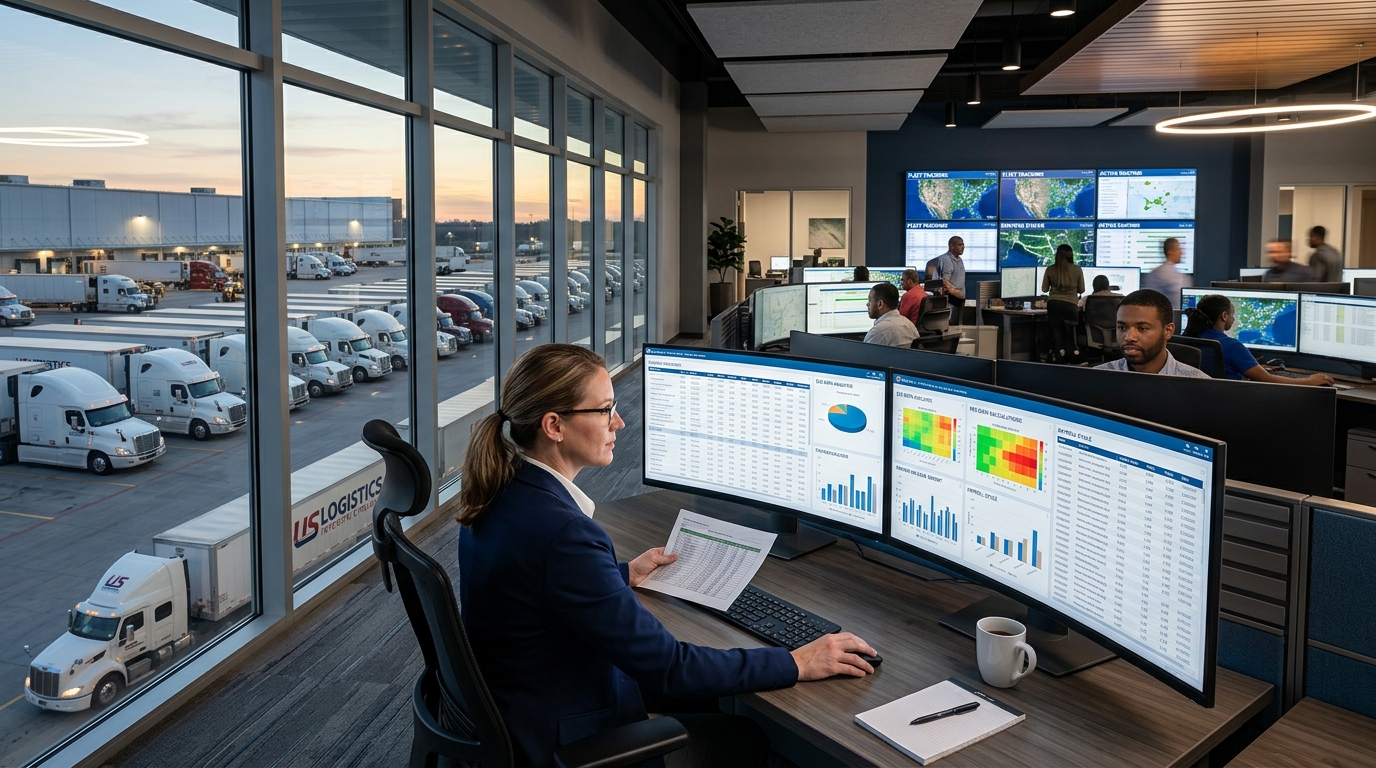
Operating a commercial trucking fleet requires navigating one of the most complex regulatory payroll environments in the United States, where compensation spans dispatch mileage, detention delays, non-taxable travel allowances, and strict interstate tax exemptions.
Executive Key Takeaways for Fleet & Payroll Executives:
- Governing Federal Statutes: 49 U.S.C. § 14503 (Amtrak Act single-state tax withholding protection), 49 CFR Part 395 (FMCSA Hours of Service), and IRC § 62(a)(2)(A) / Rev. Proc. 2011-47 (Accountable Per Diem Plans).
- Core Operational Mandate: Automate multi-tiered gross pay calculations (Cents-Per-Mile, detention, stop-off, layover) while isolating non-taxable travel per diem and restricting state income tax withholding strictly to the driver’s legal domicile state.
- Audit Liability & Penalty Exposure: IRS reclassification of unsubstantiated per diem into taxable compensation triggers 15.3% retroactive FICA assessments, 20% accuracy-related penalties under IRC § 6662, and DOT fines up to $18,170 per willful HOS falsification.
- Software Engine Automation Requirement: Direct API bi-directional synchronization between Electronic Logging Devices (ELD) / telematics units and the payroll engine to convert electronic duty logs into verifiable gross wage records without manual data entry.
(adsbygoogle = window.adsbygoogle || []).push({});
Trucking Payroll Software: Definition & Quick Operational Answer
Trucking payroll software is a specialized workforce compensation engine designed for commercial motor carriers to calculate variable mileage pay (CPM), hourly detention, and IRS Revenue Procedure 2011-47 non-taxable per diem while enforcing 49 U.S.C. § 14503 single-state tax withholding and FMCSA Hours of Service compliance across multi-jurisdictional freight operations.
Statutory Legal Framework: 49 U.S.C. § 14503, IRS Accountable Plans & DOT Regulations
Unlike conventional brick-and-mortar enterprises or localized service businesses, interstate motor carriers operate under a unique federal statutory canopy that overrides standard state nexus payroll tax laws. Navigating transportation payroll requires mastery over three primary statutory pillars.
1. The Amtrak Act: 49 U.S.C. § 14503 (State Tax Withholding Exemption)
Under standard state taxation principles (physical presence nexus), an employee who performs services within a state becomes subject to that state’s income tax withholding requirements once statutory day or dollar thresholds are breached. In interstate freight transportation, a commercial long-haul driver may cross ten state borders in a single workweek.
Congress enacted 49 U.S.C. § 14503 (originally established under the Amtrak Reauthorization and Improvement Act of 1990) to preempt state tax codes. Under federal law, no state or political subdivision may withhold or require the withholding of state or local income taxes on compensation paid to an interstate motor carrier employee who regularly performs assigned duties in two or more states, except the state of the employee’s legal residence.
If an enterprise payroll system mistakenly splits withholding across Georgia, Tennessee, Kentucky, and Ohio based on route coordinates, the carrier violates federal statutory mandates, imposes double-tax filing burdens on the driver, and generates extensive administrative cleanup liabilities.
2. IRS Accountable Per Diem Plans: Rev. Proc. 2011-47 & Notice 2024-68
Over-the-road (OTR) drivers incur substantial travel expenses for meals and incidental lodging during mandatory DOT 10-hour rest breaks and 34-hour restarts away from their home tax terminal. Under Internal Revenue Code IRC § 62(a)(2)(A) and Treasury Regulation § 1.62-2, motor carriers can reimburse drivers tax-free through an Accountable Plan using the special transportation industry Meals and Incidental Expenses (M&IE) per diem rate.
Under current IRS guidelines (Revenue Procedure 2011-47, updated annually via Notice):
- The special transportation industry per diem rate is $69.00 per full travel day for travel within the Continental United States (CONUS), and $74.00 per day for travel outside CONUS (OCONUS).
- Partial travel days (departure and arrival days) are reimbursed at 75% of the standard daily allowance ($51.75 CONUS).
- Under IRC § 274(n)(3), motor carriers operating subject to Department of Transportation hours-of-service limitations are entitled to an 80% business expense deduction for transportation per diem, rather than the standard 50% limit applied to other commercial travel.
To preserve non-taxable status, the per diem plan must satisfy three strict statutory criteria: (a) Business Connection (driver is traveling away from home terminal requiring sleep/rest under the DOT HOS rules); (b) Substantiation (verified electronic logging device dates, locations, and dispatch timestamps); and (c) Return of Excess Payments within a reasonable timeframe.
3. FMCSA Hours of Service (HOS) & 49 CFR Part 395
The Federal Motor Carrier Safety Administration (FMCSA) strictly regulates driver duty status under 49 CFR Part 395. Drivers are capped at 11 hours of driving time within a 14-hour consecutive work window following 10 consecutive hours off duty. Carriers cannot legally incentivize or schedule driving that forces an HOS violation. Furthermore, under the Fair Labor Standards Act (FLSA) Section 13(b)(1) Motor Carrier Exemption, drivers subject to FMCSA safety jurisdiction are generally exempt from federal overtime pay, but state laws (e.g., California, Washington) impose state-level overtime or rest-break pay mandates that modern trucking payroll software must calculate automatically.
(adsbygoogle = window.adsbygoogle || []).push({});
Operational Pay Structures: CPM, Detention, Accessorials & Telematics Sync
A standard small business payroll package assumes hourly wages or fixed salaries. In contrast, trucking payroll consists of dynamic multi-component compensation schemas that demand specialized enterprise features.
| Pay Category | Operational Metric | Tax Treatment | Required Software Engine Feature |
|---|---|---|---|
| Cents-Per-Mile (CPM) | Dispatched miles vs. Practical route (PC*MILER / Rand McNally) | Taxable Gross Compensation (W-2 Box 1, 3, 5) | Automated odometer/routing table validation with rate-per-mile grading |
| Transportation Per Diem | Days/nights away from home terminal per Rev. Proc. 2011-47 | Non-taxable reimbursement (Reported in W-2 Box 12, Code L) | ELD overnight rest break tracking and automated split-day calculation |
| Detention Pay | Waiting time at shipper/receiver beyond standard 2-hour free window | Taxable Regular Compensation | Geofenced arrival/departure timestamps matching electronic driver logs |
| Accessorial & Stop Pay | Intermediate drop/hook, tarping, layover, or hazardous cargo handling | Taxable Regular Compensation | Dispatch load-manifest sync with automated piece-rate triggers |
| Owner-Operator Settlement | Percentage of Gross Revenue or negotiated fuel-surcharge split | Non-employee compensation (Form 1099-NEC / 1099-MISC) | Deduction schedules (fuel card escrow, insurance, lease-purchase escrow) |
Mathematical Calculation Model: Freight Payroll & Per Diem Formula
The gross earnings calculation for an over-the-road commercial driver combines mileage earnings, accessorial remuneration, detention allowances, and accountable per diem exclusions. The mathematical model must verify that the driver’s total compensation satisfies the effective minimum wage floor across all hours logged under FMCSA duty status (Driving + On-Duty Not Driving).
Total Net Payout = [ (Dispatched Miles × CPM Base Rate) + ∑(Accessorials) + ∑(Detention Hours × Detention Rate) ] – Deductions – Taxes(Taxable Gross) + (Eligible Travel Days × IRS M&IE Rate)
Case Study: Regional Dry-Van Driver Marcus Vance
Driver Profile: Marcus Vance is a W-2 company driver domiciled in Indiana, operating on an interstate regional freight route traversing Indiana, Illinois, Wisconsin, and Ohio. For the bi-weekly pay period, his ELD and dispatch records show:
- Dispatched Loaded/Empty Miles: 4,850 miles at a base rate of $0.62 per mile.
- Overnight Travel Days: 10 full travel days away from his home terminal under IRS Rev. Proc. 2011-47 ($69.00/day CONUS rate), plus 2 partial travel days (first and last day, 75% rate = $51.75/day).
- Detention Time: 8 billable hours at warehouse facilities beyond the 2-hour free allowance, compensated at $24.00 per hour.
- Stop-Off Pay: 6 intermediate delivery stops compensated at $35.00 per stop.
- Total Logged On-Duty Hours (Driving + On-Duty Not Driving): 98.5 total recorded duty hours.
Step-by-Step Payroll Computation:
| 1. Mileage Gross Pay (4,850 miles × $0.62): | $3,007.00 |
| 2. Detention Gross Pay (8 hours × $24.00): | $192.00 |
| 3. Stop-Off Accessorial Pay (6 stops × $35.00): | $210.00 |
| Total Taxable Gross Wages (W-2 Box 1, 3, 5): | $3,409.00 |
| 4. Non-Taxable Accountable Per Diem Reimbursement [ (10 × $69.00) + (2 × $51.75) ]: | $793.50 |
| 5. Total Gross Employee Check Value (Taxable Wages + Per Diem): | $4,202.50 |
| 6. FICA Withholding – Social Security (6.2% on $3,409.00 taxable only): | -$211.36 |
| 7. FICA Withholding – Medicare (1.45% on $3,409.00 taxable only): | -$49.43 |
| 8. Federal Income Tax Withholding (Single, Standard 2026 Table Est.): | -$318.50 |
| 9. Indiana State Income Tax (49 U.S.C. § 14503: 3.05% on taxable gross only; zero IL/WI/OH withholding): | -$103.97 |
| Net Take-Home Pay Disbursed to Driver: | $3,519.24 |
Statutory Verification: Notice that statutory payroll taxes (Social Security, Medicare, Federal Income Tax, Indiana State Tax) applied strictly to the $3,409.00 taxable compensation. The $793.50 per diem was completely exempt from employee FICA and employer payroll tax burden (saving the carrier $60.70 in employer matching taxes on this single driver for this single pay run). Marcus’s effective hourly rate ($3,409.00 / 98.5 hours = $34.61/hr) comfortably clears federal and state minimum wage standards.
Trucking Payroll Software Architecture Comparison Matrix (2026)
We evaluated the leading enterprise transportation management platforms, specialized motor carrier software, and commercial payroll engines based on ELD synchronization, accountable per diem management, and multi-state compliance.
| Software Platform | Architecture & Ideal Fleet Size | ELD & Telematics Integration | IRS Accountable Per Diem Engine | 49 U.S.C. § 14503 Single-State Tax | Pricing Structure |
|---|---|---|---|---|---|
| Axon Trucking Software | All-in-one real-time ERP for mid-to-large fleets (25 to 500+ trucks) | Native live sync with Samsara, Motive, Omnitracs, Geotab | Automated split-day calculation via ELD rest break timestamps | Built-in federal interstate motor carrier tax rules | Custom enterprise quote (Per-truck monthly license) |
| Frontline Trucking Software | Dedicated freight dispatch, safety & payroll engine for small-to-mid fleets | Direct API connection with major ELD providers and PC*MILER | Full IRS Rev. Proc. 2011-47 compliant per diem tracking | Strict state domicile withholding lock | Tiered pricing based on active power units |
| ProMiles / TruckingPlanet | Mileage auditing, fuel tax (IFTA) and driver settlement engine | Odometer and GPS route log import with toll integration | Configurable per diem rates per trip or per mile | Requires external payroll export for W-2 filing | Modular pricing starting at $49/mo + usage |
| Gusto + Samsara Integration | Best for small carriers (1 to 20 trucks) using modern cloud tech | Integrated via third-party middleware or CSV dispatch export | Manual or automated non-taxable reimbursement lines | Manual configuration of driver home state override required | $40/mo base + $6/mo per active driver |
| QuickBooks Enterprise with Field Service | Established general accounting with transportation modules | Requires specialized third-party trucking add-ons | Custom payroll items for non-taxable expense items | Configurable by company payroll administrator | Annual subscription starting ~$1,830/yr |
| Tenstreet | Enterprise driver recruiting, retention, compliance and settlement | Direct telematics API integration across all Tier-1 fleets | Comprehensive settlement sheets with per diem splits | Automated regulatory interstate compliance modules | Custom enterprise fleet contract |
| ADP RUN + Transportation Add-on | Scalable multi-state compliance for mixed fleets and warehouse staff | Time-card integration via ADP Marketplace partners | Robust tax-free reimbursement coding | Full multi-jurisdictional tax filing engine | Custom quote based on frequency and headcounts |
| Rippling Unity | Modern unified workforce management for logistics and freight brokerages | Custom API triggers via webhook dispatch connectors | Custom formula calculations for per diem and accessorials | Automated state tax registration and filing | $8/mo per employee base platform fee |
IRS & DOT Audit Liabilities, Non-Compliance Penalties & Risk Mitigation
Fleet operators face dual audit jeopardy from both the Department of Labor / IRS and the Department of Transportation. Common points of exposure include:
- Unsubstantiated Per Diem Reclassification: Under IRS audit, if a carrier reimburses drivers using flat cents-per-mile per diem without logging verifiable overnight travel days away from home terminal, the entire per diem allowance is disqualified. The IRS recharacterizes the reimbursements as gross wages, issuing retroactive assessments for employer and employee FICA (15.3%), FUTA (0.6%), federal income tax withholding liabilities, plus a 20% accuracy-related penalty under IRC § 6662 and statutory interest.
- Improper Multi-State Withholding: Failing to adhere to 49 U.S.C. § 14503 by withholding taxes in jurisdictions where a driver only performed transit driving exposes the motor carrier to administrative citations and legal disputes with state revenue departments.
- FMCSA Falsification Fines: If a carrier uses mismatched dispatch miles and ELD logs to underreport driving time or circumvent 11-hour driving rules, the FMCSA imposes fines up to $18,170 per occurrence under 49 CFR Part 386 for knowing record falsification.
- Owner-Operator 1099 Misclassification: Under the Department of Labor 2024 Independent Contractor Final Rule (29 CFR Part 795) and state-level ABC tests, retaining significant operational control over lease-purchase owner-operators (e.g., dictating routes, requiring specific vendors, prohibiting outside dispatch) can result in classification re-assignment to W-2 employees, with retroactive workers’ compensation and overtime liabilities.
(adsbygoogle = window.adsbygoogle || []).push({});
Frequently Asked Questions for Fleet Operators
Does an interstate truck driver pay state income tax in every state they drive through?
What is the IRS standard per diem rate for transportation workers in 2026?
How does a carrier substantiate per diem to satisfy IRS accountable plan rules?
Are interstate truck drivers entitled to overtime pay under the FLSA?
Can trucking payroll software automatically process 1099 owner-operator settlements?
{
“@context”: “https://schema.org”,
“@type”: “FAQPage”,
“mainEntity”: [
{
“@type”: “Question”,
“name”: “Does an interstate truck driver pay state income tax in every state they drive through?”,
“acceptedAnswer”: {
“@type”: “Answer”,
“text”: “No. Under 49 U.S.C. § 14503 (the Amtrak Act), interstate commercial motor carrier employees who regularly perform duties in two or more states are legally subject to state income tax withholding only in their state of legal domicile. Motor carriers are federally prohibited from withholding income taxes in transit states.”
}
},
{
“@type”: “Question”,
“name”: “What is the IRS standard per diem rate for transportation workers in 2026?”,
“acceptedAnswer”: {
“@type”: “Answer”,
“text”: “Under IRS Revenue Procedure 2011-47 and annual updating notices, the special transportation industry Meals and Incidental Expenses (M&IE) per diem rate is $69.00 per day for travel within the continental United States (CONUS) and $74.00 per day for travel outside the continental United States (OCONUS). Partial travel days are reimbursed at 75% ($51.75 CONUS).”
}
},
{
“@type”: “Question”,
“name”: “How does a carrier substantiate per diem to satisfy IRS accountable plan rules?”,
“acceptedAnswer”: {
“@type”: “Answer”,
“text”: “Carriers must substantiate three elements: (1) Business connection: the driver must be dispatched away from their home tax terminal requiring lodging or rest under FMCSA HOS rules; (2) Time and place: documented via electronic logging device (ELD) records and dispatch manifests; and (3) Excess return: any unearned travel advance must be repaid within 120 days.”
}
},
{
“@type”: “Question”,
“name”: “Are interstate truck drivers entitled to overtime pay under the FLSA?”,
“acceptedAnswer”: {
“@type”: “Answer”,
“text”: “Under the Section 13(b)(1) Motor Carrier Exemption of the Fair Labor Standards Act, commercial drivers operating vehicles exceeding 10,000 lbs GVWR in interstate commerce subject to FMCSA safety regulations are exempt from federal overtime pay. However, individual states such as Washington and California impose localized overtime or paid rest break rules that motor carriers operating within those boundaries must review with labor counsel.”
}
},
{
“@type”: “Question”,
“name”: “Can trucking payroll software automatically process 1099 owner-operator settlements?”,
“acceptedAnswer”: {
“@type”: “Answer”,
“text”: “Yes. Specialized transportation payroll platforms such as Axon, Frontline, and Tenstreet generate weekly or per-load settlement sheets for independent contractor owner-operators. These platforms automatically deduct fuel card advances, physical damage insurance, trailer lease payments, and maintenance escrow before disbursing net settlements and compiling annual Form 1099-NEC reports.”
}
}
]
}
Executive Benchmarks & Related Regulatory Guides
Explore cross-referenced statutory rules, vendor cost evaluations, and operational guides:
- Davis-Bacon Certified Payroll Software (2026): Prevailing Wage & Fringe Benefit Automation Guide [Industry Solutions]
- Best Payroll Software for Real Estate Brokerages (2026): Commission Splits & 1099-NEC [Industry Solutions]
- Patriot vs. Gusto (2026): Low-Cost Flat Rate vs. Full-Service Payroll Comparison [Payroll Software]